
MAIN ATRACTIONS:

Tundavala Rift
A natural window from the Huíla plateau to the Namibe Desert, the wonderful Fenda da Tundavala is located at a little more than two thousand meters of altitude, surrounded by imposing cliffs, over the Chela mountain range. It has a distance of approximately 15 kilometers west of the city of Lubango, capital of the province of Huíla. The site, due to its attractive beauty and characteristics conducive to tourism, was classified as a natural and cultural landscape, by Executive Decree No. 5/12 of 9 August, of the Government of Angola.
Native communities also consider it to be the place where the spirits of their ancestors take refuge, shutting themselves in invisible drawers.

Kalandula Falls
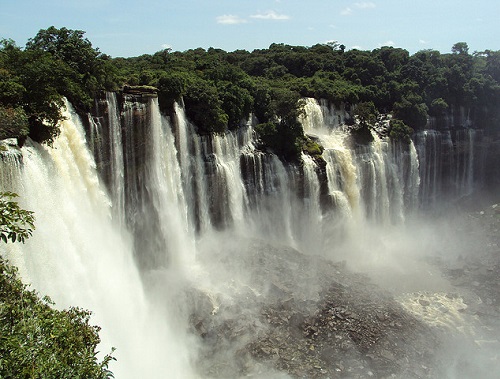
Kalandula Falls are the postcard visit to Angola. Located on the Lucala River, the most important tributary of the Cuanza River, they are the second highest falls in Africa, measuring 410 meters long and 105 meters high.
They are about 80 km from the city of Malanje, capital of the province, and 420 km from Luanda. In addition to an unparalleled landscape, they are also suitable for bathing.
Iona National Park
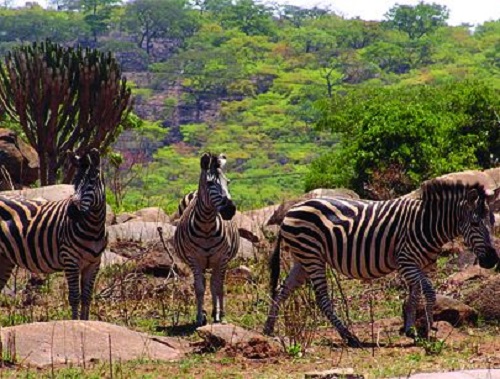
Iona National Park, in the province of Namibe. Established as a National Hunting Park in 1937, it became a National Park in 1964. It has an area of 15,150km² where herds of fan goats (Springboks), Orix, Zebras, Ostriches, among others, are easily spotted, with Orix being the main star of its fauna.
It also has a diverse flora, especially the world known Welwitschia Mirabilis.
Maiombe Forest
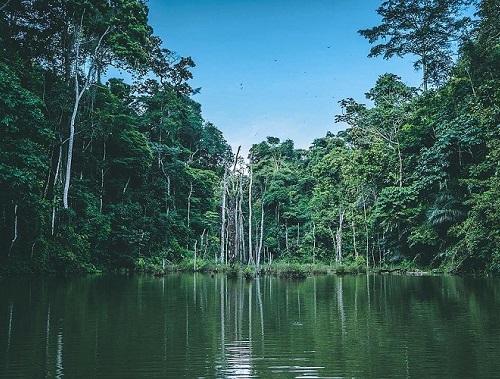
Maiombe Forest, It is located in the northern region of the Province of Cabinda, bordering Congo Brazzaville and the Democratic Republic of Congo, occupying a vast territorial extension of 290 thousand hectares, distributed between the municipalities of Buco Zau (communes of Inhuca and Necuto ) and Belize (communes of Miconge and Luali). It presents a dense vegetation with leafy trees with 50 meters of height where we can highlight the Pau-Rosa, Ngulo Mazi, among others.
The fauna is made up of large animals such as Elephants, Rhinos, Pacaças, various primates such as gorillas, chimpanzees, small monkeys and sloths, various types of rodents, rare birds such as the gray parrot and parakeets.
Cabo Ledo and Surf spot
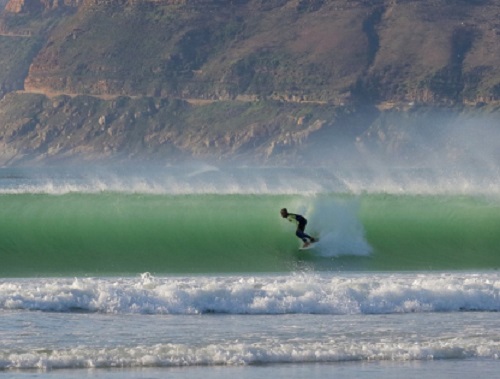
Cabo Ledo anda Surf Spot are located in the province of Bengo, about 120 kilometers south of the capital Luanda. It has the most popular surf spot in the country where some competitions are already being rehearsed. Praia dos Surfistas, with clear water and white sand, is one of the best natural wave beaches in ANGOLA

Nzenzo Caves
The Nzenzo Caves are a recently discovered site. Its still virgin and completely preserved beauty was discovered by the Provincial Government of Uíge, through the Provincial Directorate of Hotels and Tourism.
The Turi-Uíge project has been developed, with actions aimed at discovering, surveying and taking advantage of existing tourist sites, which can boost the Nzenzo Caves in the tourist sector.
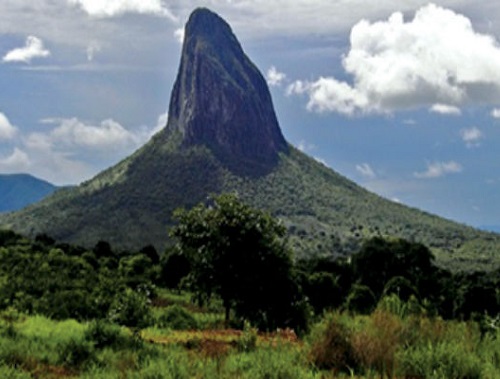
Morro do Môco is the highest point in Angola. It is located in the province of Huambo, in the municipality of Londuimbali and has an altitude of 2,620 m. Here remain 85 hectares of mountain forest, the most threatened habitat in Angola.
Here is the refuge of several rare and endemic species, such as the Francolim of Swierstra. From the point of view of sustainable nature tourism, it is a challenge for rappel and canyoning practitioners.
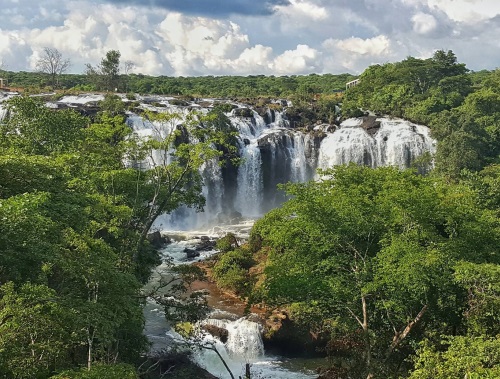
Chiumbe River Falls
The Chiumbe River Falls are located near the municipality of Dala, next to the bridge that connects the road from Lunda Sul Province to Moxico. No one is indifferent to their passage, where the river that gives them their name creates a landscape of rare beauty.